

Frances Emily Nesbitt
English ( b.1863 - d.1934 )
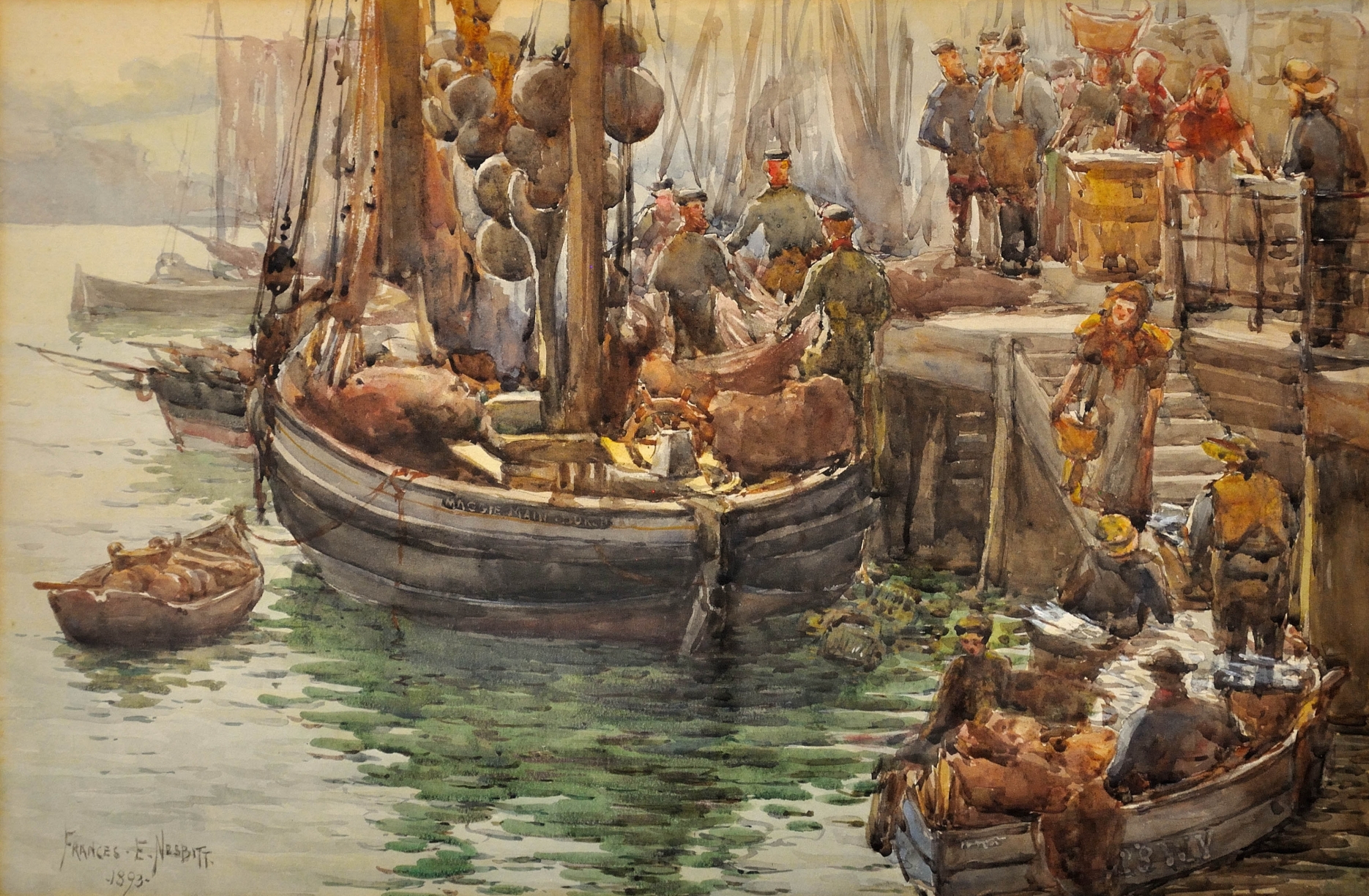
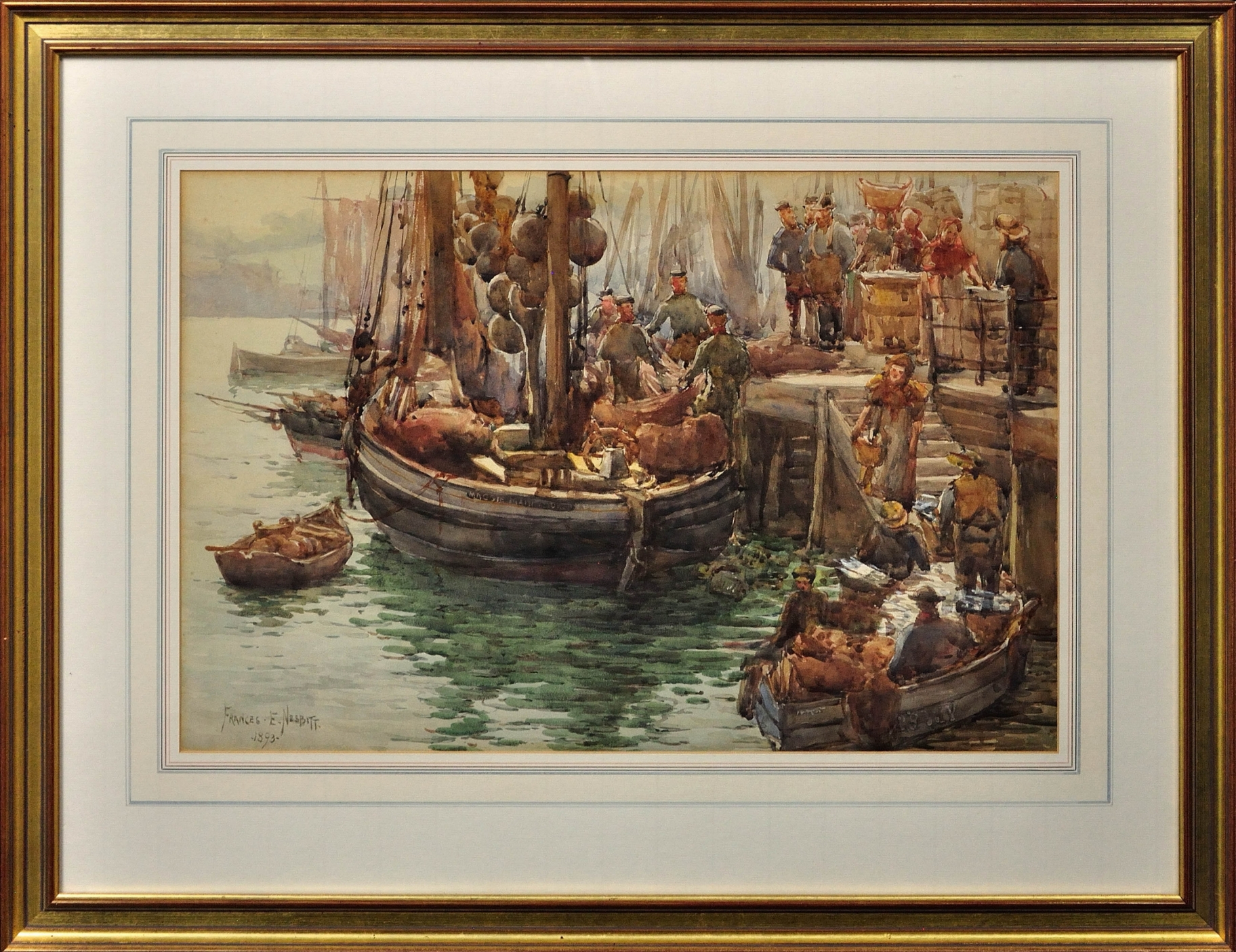
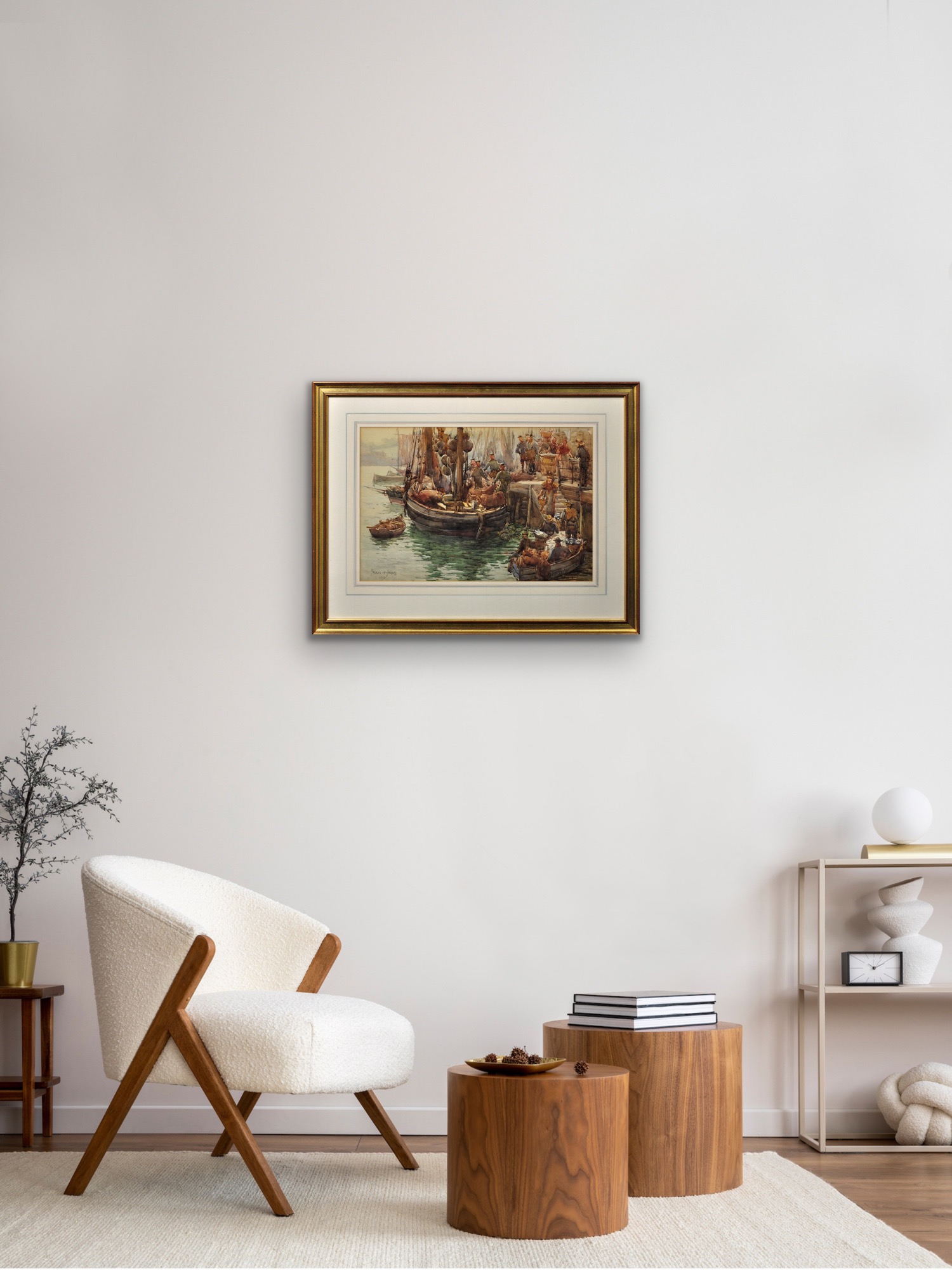
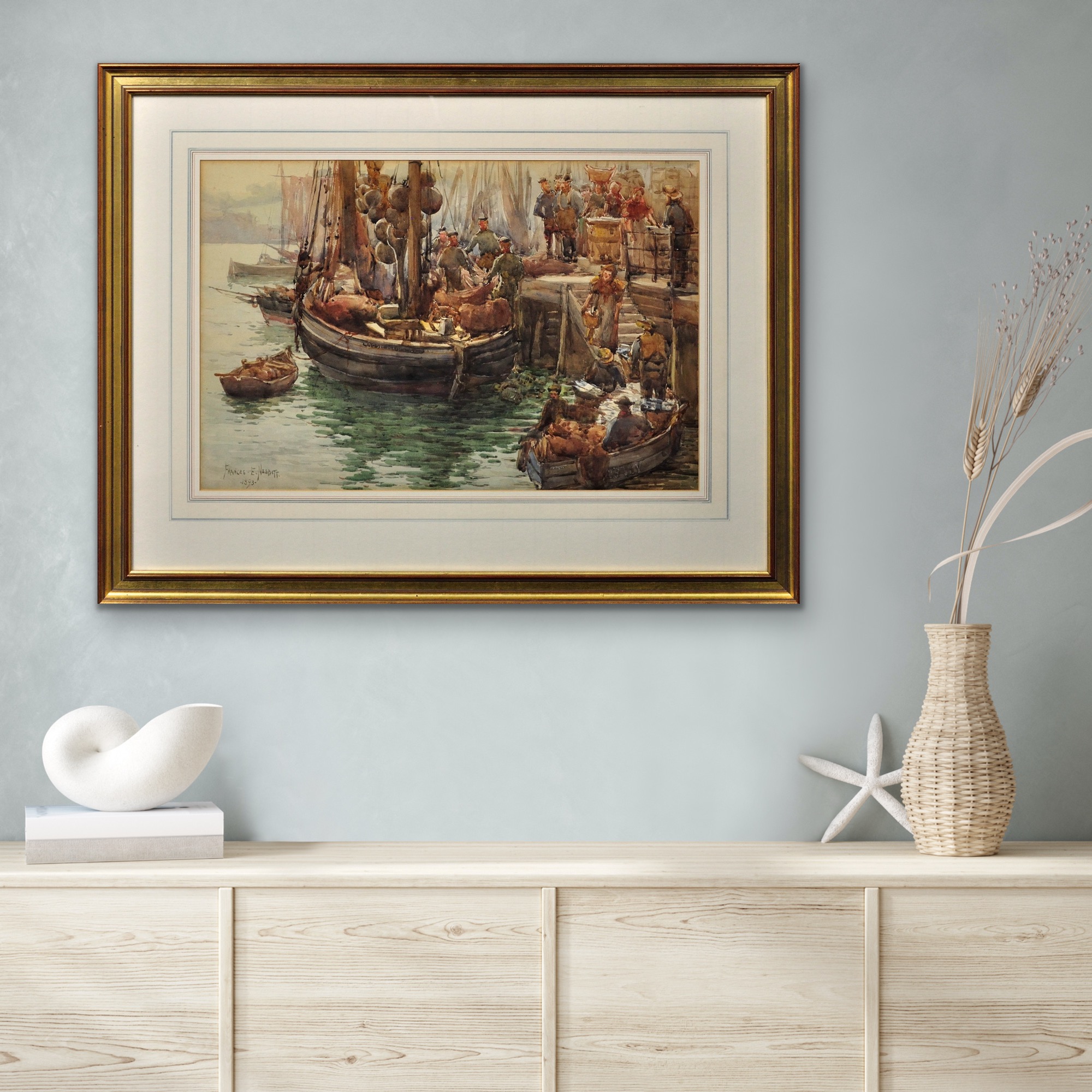
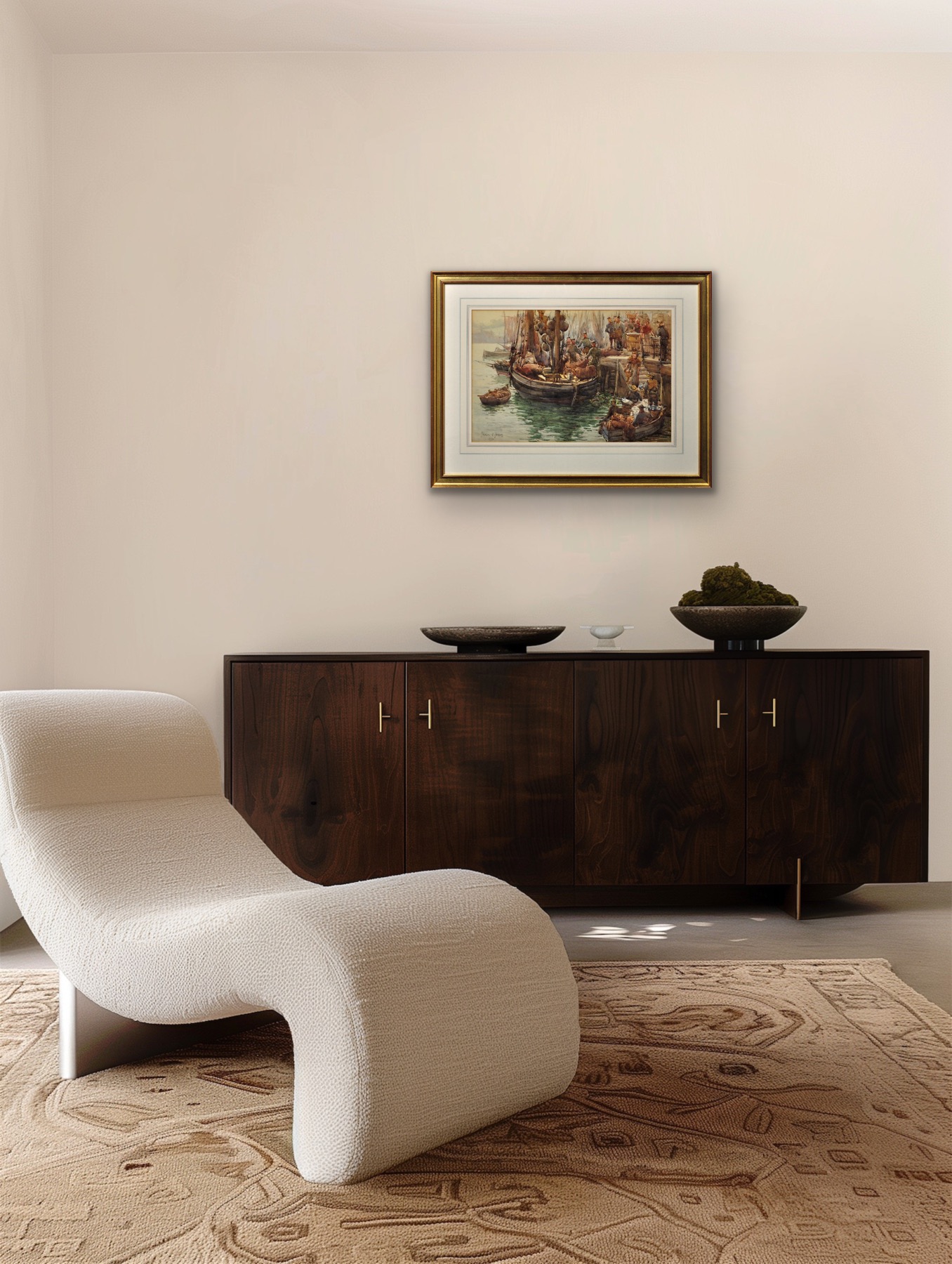
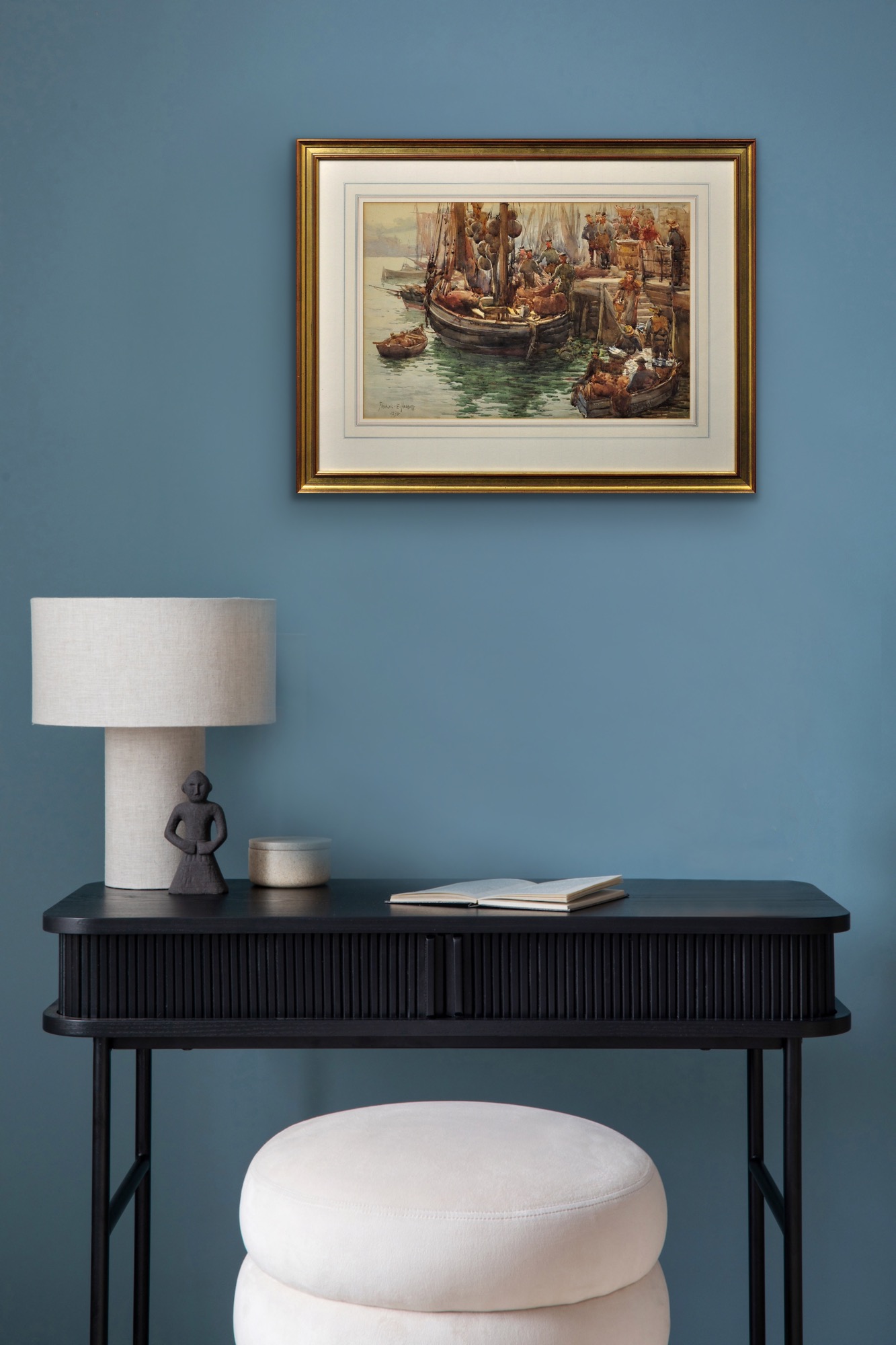
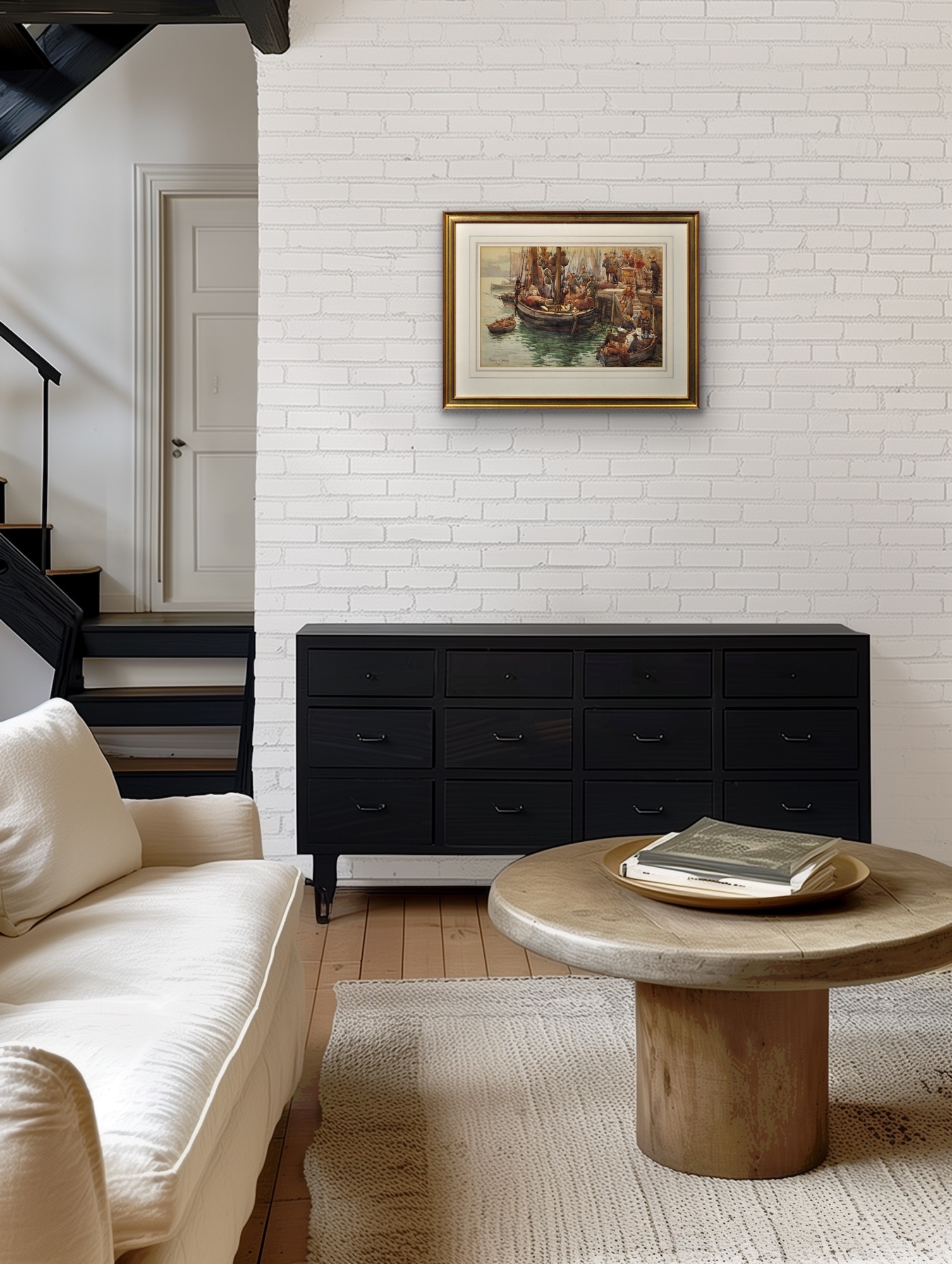
A Moray Firth Zulu Fishing Boat Unloading Herring In Whitby, 1893.
| Image size | 13.8 inches x 20.5 inches ( 35cm x 52cm ) |
| Frame size | 22.4 inches x 28.9 inches ( 57cm x 73.5cm ) |
£1,495.00
Available for sale from Big Sky Fine Art in the English county of Dorset, this original painting is by the English female artist Frances Emily Nesbitt and is dated 1893.
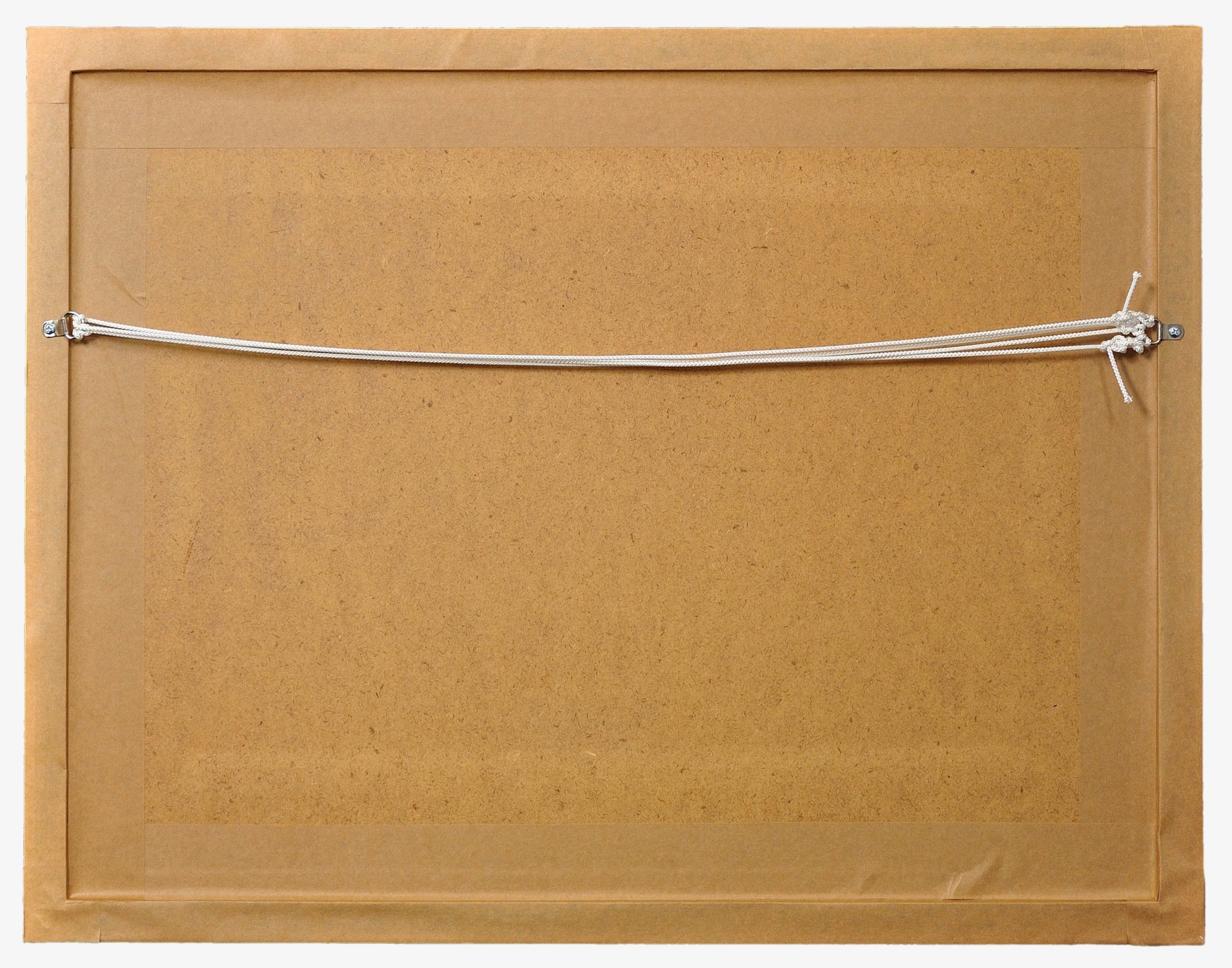
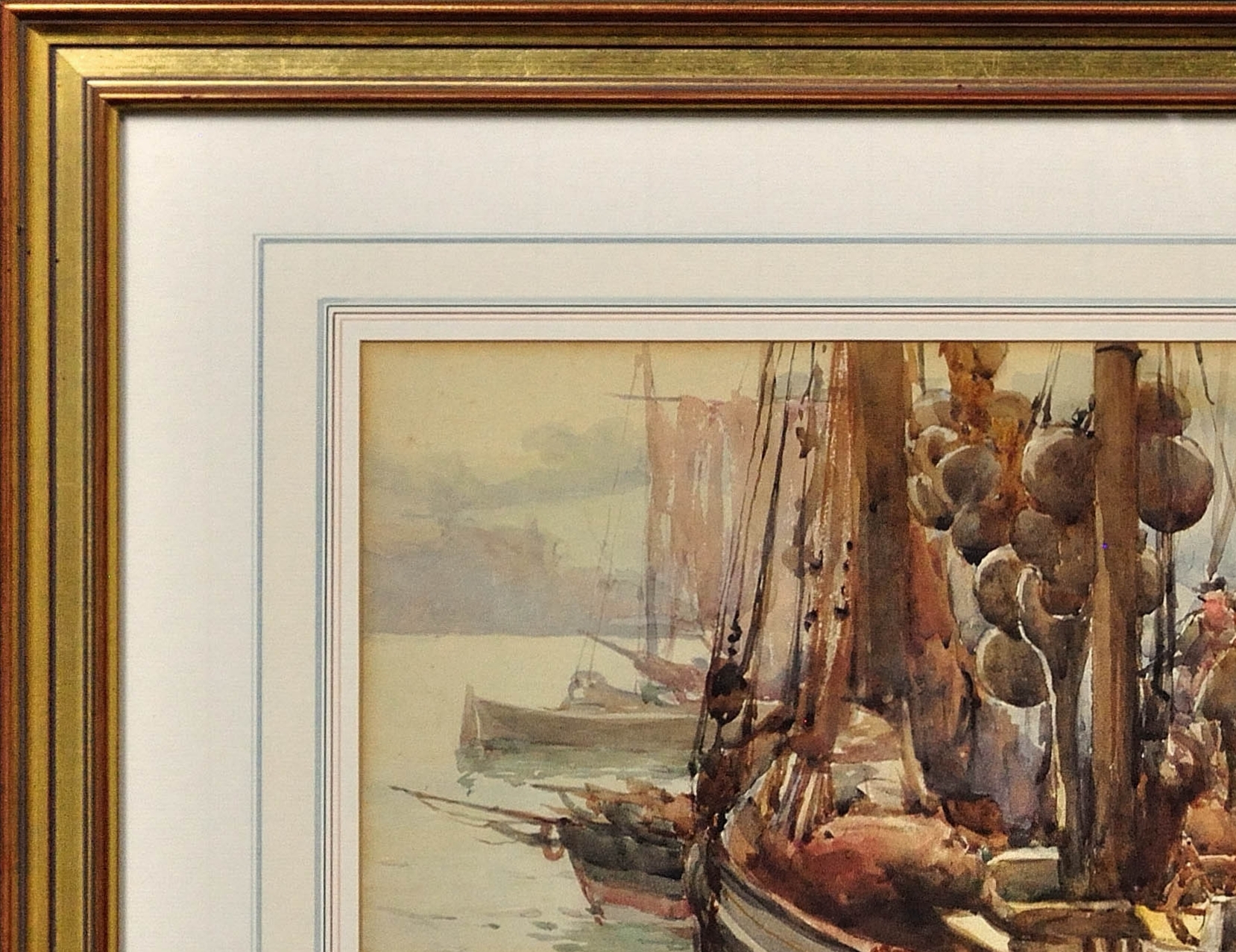
The watercolour is presented and supplied in a glazed frame dating from the 1960s (which is shown in these photographs). New hanging fittings and cord have replaced the aged items to ensure security. The framing materials are in good condition.
This antique watercolour painting is in very good condition. It wants for nothing and is supplied ready to hang and display.
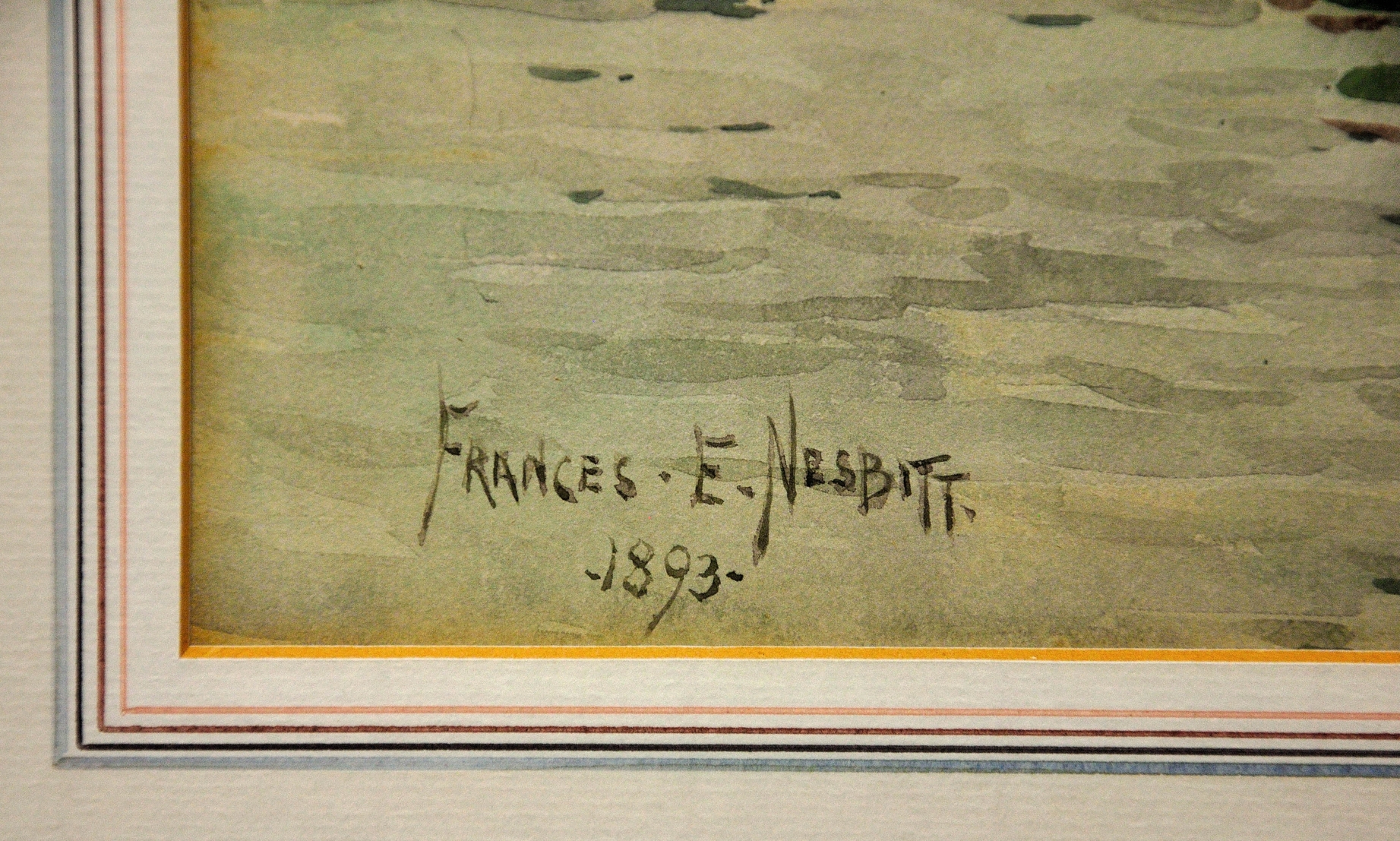
The watercolour is signed and dated lower left.
Frances Emily Nesbitt was an accomplished English watercolour painter, illustrator and travel writer, best known for her atmospheric landscapes, architectural subjects, coastal scenes and depictions of everyday life encountered during her extensive travels throughout Europe and North Africa. Working during the late Victorian and Edwardian periods, she developed a distinctive style characterised by careful observation, confident draughtsmanship and a sensitive handling of light and colour. Her paintings frequently combine an interest in architectural and topographical detail with lively representations of local people, customs and activities.
Nesbitt was born on 23 October 1863 at Mountfield Place, Wolverhampton, Staffordshire, and baptised on 3 December of that year. She was the daughter of Francis Albert Nesbitt (1832–1866), a surgeon, and his wife Emily, née Fyson (c.1845–1918). Her father died when Frances was still a young child, leaving her mother to raise Frances and her younger brother, Henry Frank. By the time of the 1871 census, the family was living in Ipswich, Suffolk, where Frances subsequently attended the Ipswich School of Art. Her early artistic education provided the foundations for a career which would encompass painting, illustration, writing and extensive international travel.
From an early stage in her adult life, Nesbitt travelled widely, frequently accompanied by her widowed mother. Their journeys took them through France, Germany, Italy, Norway and the Netherlands, where Frances pursued her interests in history, architecture and the distinctive character of the places they visited. An accomplished linguist, she was able to engage more fully with the countries and communities she encountered. These travels provided an abundant source of artistic inspiration, and she produced numerous watercolours recording historic buildings, landscapes, harbours, street scenes and the daily activities of local inhabitants.
At a time when extensive international travel was considerably less accessible to women than it is today, Nesbitt’s journeys reflected an adventurous spirit, intellectual curiosity and a considerable degree of independence. Rather than concentrating solely upon celebrated monuments or picturesque scenery, she frequently turned her attention to working communities, markets, streets and harbours, capturing the atmosphere and character of ordinary life. Her paintings reveal both a keen observational eye and an appreciation of the relationship between people and their surroundings.
Her travels eventually extended beyond Europe into North Africa and the eastern Mediterranean, including Algeria, Tunisia, Egypt and Palestine. These journeys became particularly important to her artistic career. The brilliant Mediterranean light, distinctive architecture, vibrant street life and contrasting colours of the North African landscape offered subjects ideally suited to her watercolour technique. Her paintings of these regions demonstrate an assured handling of architectural detail, together with an ability to convey the warmth, colour and atmosphere of the places she visited.
In 1903, an exhibition at the Graves Galleries brought together approximately seventy of her watercolour drawings depicting subjects from Algeria, Egypt, Palestine, Italy and Spain. The scale and geographical range of this exhibition illustrate both her remarkable productivity and the extent to which travel had become central to her artistic career.
Her experiences in North Africa also provided the inspiration for her illustrated travel book, “Algeria and Tunis”, published in London by A. & C. Black in 1906. The book, which she both wrote and illustrated, was the result of approximately two years spent travelling through the region. It formed part of the publisher’s celebrated series of illustrated travel books, often known as Black’s Beautiful Books, which combined descriptive writing with high-quality colour reproductions of original artwork.
An accomplished work of travel writing and illustration, “Algeria and Tunis” provides a detailed account of the history, architecture, landscapes and everyday life of North Africa during the early twentieth century. Its descriptions and numerous watercolour illustrations offer a valuable historical record of the region at that time. The publication represented a significant achievement, demonstrating Nesbitt’s abilities not only as a painter but also as a knowledgeable and perceptive travel writer.
Alongside her travels and literary work, Nesbitt maintained an active exhibition career in Britain. She exhibited at numerous important artistic institutions, including the Royal Academy, the Royal Society of British Artists, the Royal Institute of Painters in Water Colours, the Royal Institute of Oil Painters, the Royal Hibernian Academy, the Walker Art Gallery in Liverpool and the Society of Women Artists.
She was particularly closely associated with the Society of Women Artists, to which she was elected an Associate in 1899, exhibiting more than one hundred works with the organisation during her career. Her participation placed her among a growing community of professional women artists seeking recognition and opportunities to exhibit their work at a time when the established artistic institutions remained predominantly male.
Contemporary exhibition records reveal the considerable variety of her subjects. These included “Flower Girls in Regent Street”, exhibited at the Royal Institute of Painters in Water Colours in 1896; “Whitby”, exhibited at Suffolk Street in 1898; “Ilfracombe”, exhibited at the Dudley Gallery in 1900; and “Jerusalem”, exhibited there in 1902. Such works demonstrate the breadth of her interests, encompassing British coastal and urban life alongside subjects encountered during her international travels.
Although her travels frequently took her abroad, Nesbitt maintained connections with several parts of England. Exhibition and biographical records associate her with London during the 1880s and early twentieth century, Ilfracombe in Devon around 1900, Louth in Lincolnshire in 1901, and Hertfordshire during her later years. Her mother’s address at 49 Roland Gardens, Kensington, also appears in family probate records, providing a further connection with London.
Throughout her career, Nesbitt worked principally in watercolour, a medium particularly well suited to her interests in travel, architecture and atmospheric effects. Her paintings combine an accomplished understanding of perspective and composition with a lively and sometimes impressionistic freedom of brushwork. Figures frequently play an important role in her compositions, bringing scale, movement and narrative to scenes which might otherwise be primarily architectural or topographical.
Her treatment of colour is equally distinctive. Whether depicting the muted light of a British harbour or the stronger contrasts of a North African street, she demonstrated an ability to adapt her palette to the character of the subject. Her paintings possess both documentary value and considerable artistic merit, recording places and ways of life with sensitivity and an evident interest in the people who inhabited them.
The original watercolour “A Moray Firth Zulu Fishing Boat Unloading Herring in Whitby”, painted in 1893, provides an excellent example of her British maritime subjects. The painting depicts the busy working life of Whitby harbour, with Scottish fishing vessels, fishermen and fish workers engaged in unloading the herring catch. Its carefully observed details of boats, rigging, figures and fishing equipment demonstrate Nesbitt’s interest in the practical activities of everyday life, while her accomplished handling of colour, reflections and atmosphere gives the composition a strong sense of immediacy. Painted before her major North African travels and publications, it illustrates the observational skills and artistic confidence already evident in her work during the 1890s.
Frances Emily Nesbitt died on 12 January 1934 at Hilltop, Bovingdon, Hertfordshire, aged seventy. Her estate was valued at approximately £38,270, a substantial sum at the time.
Nesbitt’s career represents a notable contribution to British watercolour painting during a period of increasing opportunities for professional women artists. Her extensive travels, linguistic abilities, regular participation in major exhibitions and achievements as both an artist and published author distinguish her as an unusually enterprising and independent figure of her generation.
© Big Sky Fine Art
A wonderfully detailed and atmospheric original watercolour by the English artist Frances Emily Nesbitt (1863–1934), depicting a bustling scene of fishing boats, fishermen and dockside activity in the historic North Yorkshire fishing port of Whitby in 1893.
This 1893 watercolour painting depicts the Moray fishing boat called “Maggie Main” who’s home port is Burghead. Records from 1899 show that “Maggie Main: carried the port letters and number INS983. The boat was classed as a Zulu 1st class with a length over keel of 50feet. The boat is recorded as being registered to a Mr Daniel Main of Hopeman, Both Burghead and Hopeman are settlements on the Moray Firth near Elgin with small harbours.
The surname Main occurs in high concentrations in the county of Morayshire (formerly known as Elginshire up until 1919). The Main family name is significant and synonymous with the fishing heritage along the Moray Firth.
The composition centres upon a traditional Scottish Zulu fishing boat, a distinctive type of sailing vessel developed on the Moray Firth coast during the late nineteenth century and widely used in the North Sea herring fisheries. Moored alongside the harbour quay, the vessel is surrounded by fishermen and fish workers engaged in the demanding business of unloading and handling the day’s catch. Its substantial wooden hull, tall masts, intricate rigging and fishing equipment are depicted with considerable attention to detail, providing a fascinating record of the working fishing vessels of the period.
Nesbitt captures the energy and activity of the harbour with an engaging collection of figures, each absorbed in their individual tasks. Fishermen work aboard the vessel and along the quayside, while women in traditional working dress carry baskets and attend to the fish. In the foreground, smaller boats laden with baskets and fishing equipment occupy the sheltered harbour waters, adding further interest and depth to the composition. The presence of numerous figures, together with the carefully observed details of the boats and their equipment, conveys the industrious character of a busy Victorian fishing port.
The artist’s accomplished handling of watercolour is particularly evident in her treatment of light and atmosphere. A restrained palette of warm ochres, earthy browns, muted reds and soft greys contrasts with the delicate greens and silvery reflections of the harbour water. Loose, expressive brushwork captures the movement of the water and the shifting effects of light, while more precise passages of drawing define the boats, figures and architectural details. The softly rendered background, with its suggestion of further vessels and harbour buildings, creates a convincing sense of space without distracting from the activity in the foreground.
The painting is also of considerable historical and maritime interest. During the late nineteenth century, Whitby was an established centre of the North Sea fishing industry, and the seasonal herring fisheries attracted vessels and crews from fishing communities along the eastern coasts of Britain. The presence of a Moray Firth Zulu fishing boat in Whitby illustrates the geographical reach of the Scottish herring fleets and the connections between the fishing ports of Scotland and northern England.
Painted in 1893, this watercolour provides an evocative visual record of a working harbour at a time when commercial fishing remained heavily dependent upon sail, manual labour and traditional methods of handling the catch. Beyond its documentary interest, it is an accomplished example of late Victorian British marine and coastal painting, combining lively figurative observation with an assured sense of composition, colour and atmosphere.
The painting is signed and dated 1893 by Frances Emily Nesbitt in the lower left corner.
 A Moray Firth Zulu Fishing Boat Unloading Herring In Whitby, 1893. - Nesbitt, Frances Emily